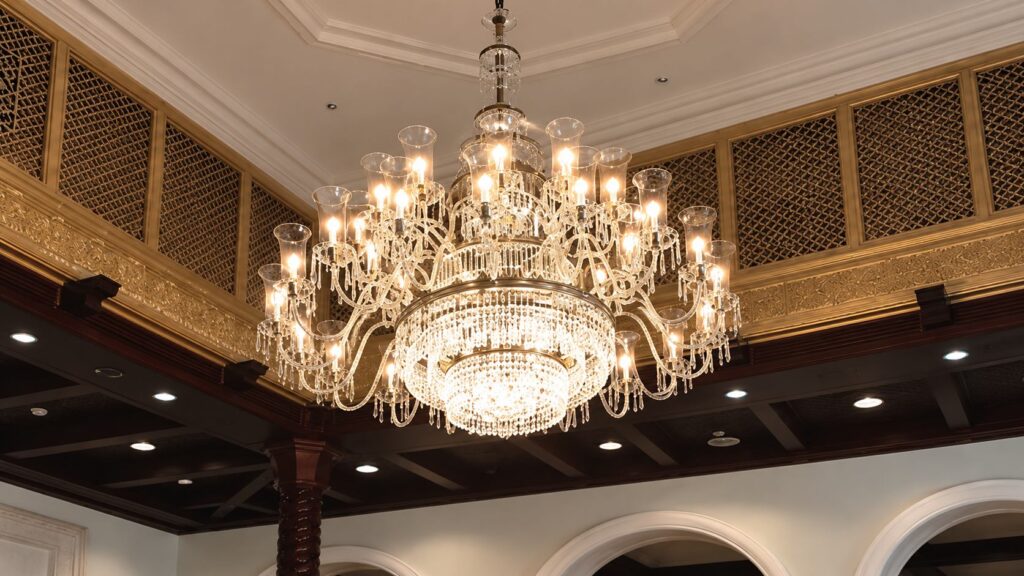
Bespoke decorative lighting for one of Dubai’s most distinguished hospitality interiors
In luxury hospitality, decorative lighting does more than illuminate a space; it helps define the atmosphere guests experience from the moment they enter.
For the Ritz Carlton Hotel project in Dubai, UAE, Tikanna provided customized decorative lighting fixtures and a comprehensive lighting solution developed around the needs of different hotel spaces. Working alongside the hotel design team, Tikanna delivered bespoke crystal chandeliers and artistic decorative lighting designed to complement the property’s refined interior environment.
One of the most distinctive pieces is a large multi-tier crystal chandelier—a decorative focal point that demonstrates how scale, material, proportion and light can work together in a luxury hospitality interior.
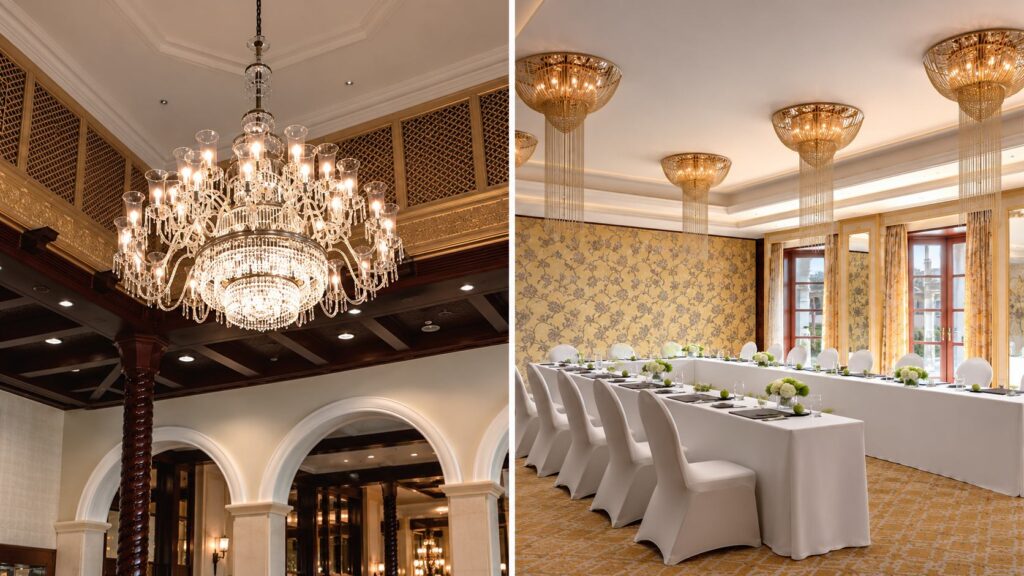
The Project: Custom Lighting for a Luxury Hotel in Dubai
Dubai’s hospitality market is known for interiors where architecture, materials and decorative details all contribute to the guest experience.
For a luxury hotel project, this means decorative lighting cannot be selected only by appearance. The fixture must also respond to the scale of the space, the surrounding finishes, the interior design language and the atmosphere the designer wants to create.
For the Ritz Carlton Hotel project, Tikanna developed customized decorative lighting for different functional areas rather than applying one standard lighting solution throughout the property. This is especially important in hospitality projects, where a lobby, restaurant, corridor, lounge and guest area can require completely different decorative lighting approaches.
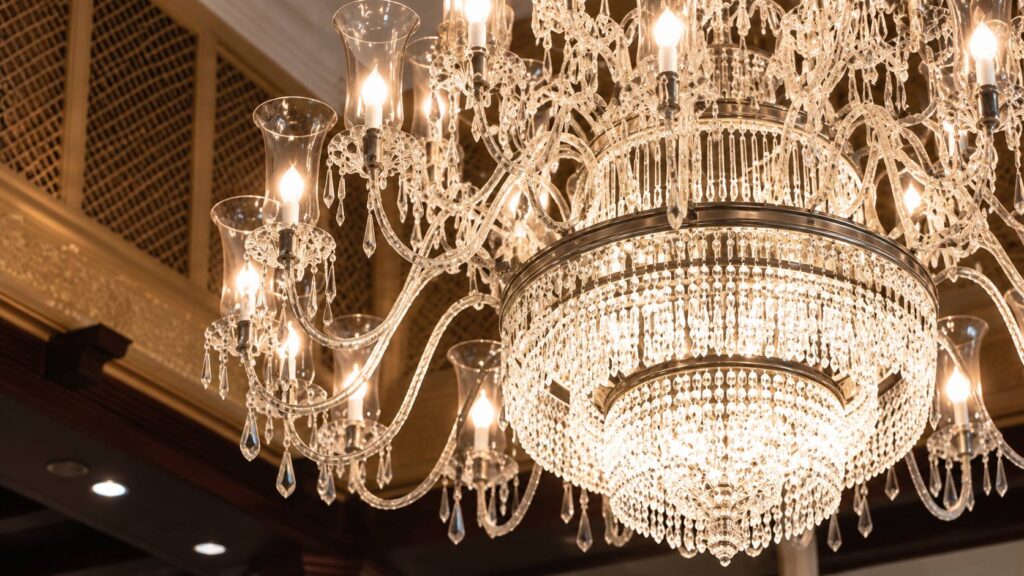
Creating a Statement with a Large Crystal Chandelier
The large crystal chandelier featured in this project uses a traditional chandelier language but develops it at a scale appropriate for a luxury hotel environment. Multiple tiers of crystal and decorative arms create a strong vertical composition.
Instead of functioning simply as a light source, the chandelier becomes part of the interior architecture.
This distinction is important when developing statement lighting for hotels. A chandelier for a residential dining room can be treated as an individual decorative object. A chandelier for a hotel public space must be considered in relation to:
- ceiling height and architectural proportions
- viewing distance and sightlines
- surrounding furniture and finishes
- visual weight
- suspension and structural requirements
- lighting atmosphere
- installation and maintenance
The objective is not simply to make the fixture larger. The objective is to make it belong to the space.
Why Crystal Works in Luxury Hospitality Interiors
Crystal remains an effective material for statement hotel lighting because its appearance changes with both natural and artificial light.
During the day, transparent crystal can interact with daylight and surrounding architectural finishes. At night, illumination within the chandelier creates reflections, highlights and depth throughout the decorative structure.
In the Ritz Carlton Dubai project, the crystal chandelier works together with the hotel’s refined architectural environment rather than appearing as an isolated decorative object. The result is a fixture that provides both illumination and a strong visual focal point.
Custom Lighting Starts with the Interior, Not the Fixture
One of the most important differences between standard decorative lighting and project-based custom lighting is where the design process begins.
For a standard product, the buyer normally selects an existing fixture and then decides where to install it. For a custom hotel project, the process often works in the opposite direction.
The designer begins with the space. The lighting solution then needs to respond to that space. This may involve adjusting the chandelier’s scale, proportions, suspension, materials, finish or decorative details so that the finished fixture works with the overall interior concept.
The Ritz Carlton Dubai project included bespoke crystal chandeliers and artistic lighting developed for different functional spaces, reflecting this project-specific approach.
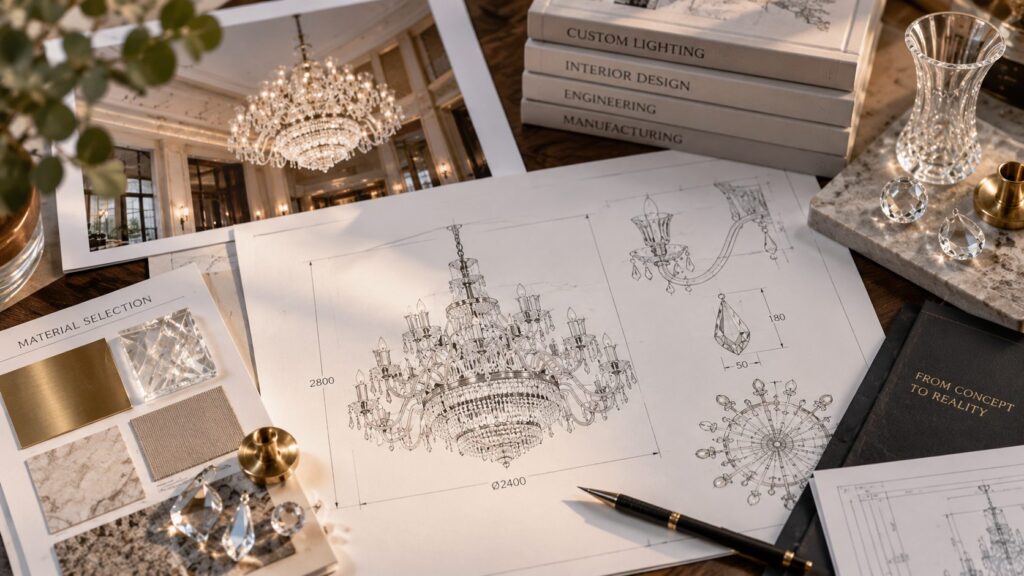
From Design Intent to a Manufacturable Fixture
For interior designers and contractors, one of the biggest questions in custom lighting is: Can the original design intent actually be manufactured?
A beautiful concept is only the beginning. Before a custom chandelier enters production, several practical factors normally need to be evaluated: dimensions and proportions, materials and finishes, structural construction, suspension method, electrical configuration, component assembly, packing and installation conditions.
This is where collaboration between the designer and lighting manufacturer becomes important. The goal is not to change the designer’s idea unnecessarily. It is to translate that idea into a fixture that can actually be produced and installed while preserving the intended visual effect.
For international hotel projects, this becomes especially important because manufacturing and final installation may take place in different countries.
One Hotel, Different Lighting Requirements
The Ritz Carlton project also demonstrates another important principle of hotel lighting: not every space needs the same type of statement.
The project included customized decorative lighting solutions for different functional spaces. A major chandelier can create a visual focal point in a prominent public area, while other areas may require smaller decorative pendants or more restrained artistic lighting.
For designers, this creates a more coherent hospitality experience. Instead of filling the hotel with unrelated decorative fixtures, lighting can be developed as a coordinated collection—different in scale and function, but connected through materials, finishes or design language.
What Designers Should Consider Before Customizing a Large Hotel Chandelier
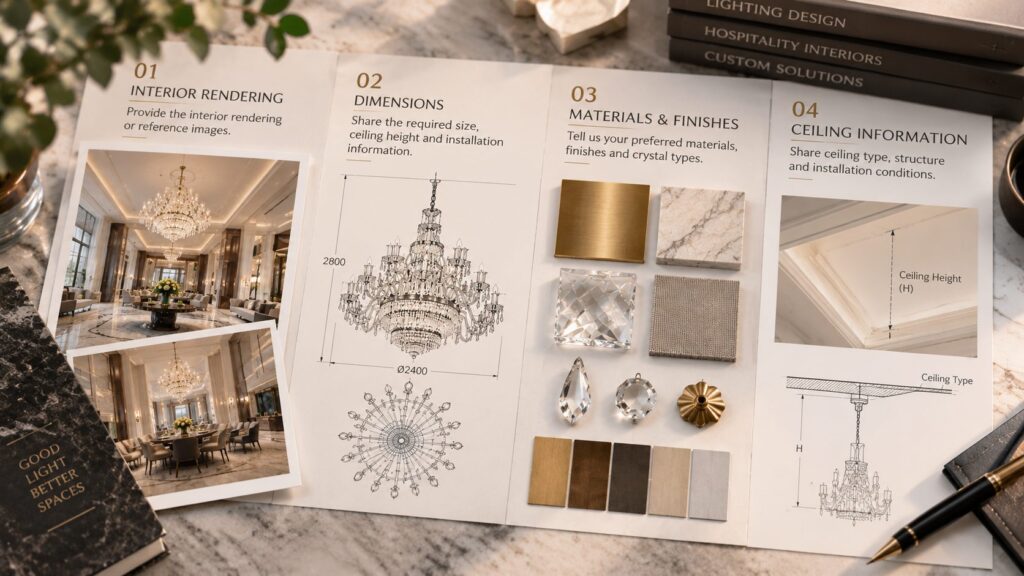
For a large decorative fixture, early information makes the development process much more efficient. Before approaching a manufacturer, designers and contractors can prepare the interior rendering or reference image, approximate dimensions, ceiling height, preferred materials and finishes, installation location, quantity and project schedule.
Complete production drawings are not always necessary at the beginning. A rendering, sketch or reference image can already provide useful information about the design direction. The manufacturer can then evaluate which parts of the concept require further technical development before production.
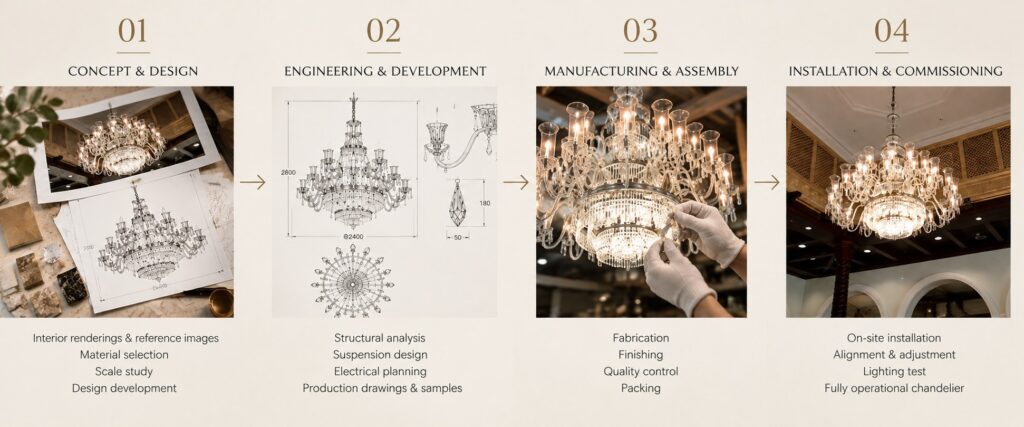
| Project Phase | Key Activities | Deliverables |
| Concept & Design | Interior renderings, material selection, scale study | Design brief & reference images |
| Engineering & Development | Structural analysis, suspension design, electrical planning | Production drawings & samples |
| Manufacturing & Assembly | Fabrication, finishing, quality control, packing | Finished fixture & installation guide |
| Installation & Commissioning | On-site installation, alignment, lighting adjustment | Installed & fully operational chandelier |
Custom Hotel Lighting for International Projects
The Ritz Carlton Dubai project is one example of Tikanna’s work in international hospitality lighting. The project involved customized decorative fixtures and lighting solutions developed around different hotel spaces, combining bespoke crystal chandeliers and artistic lighting with the property’s luxury interior environment.
For designers and contractors, the value of a custom lighting manufacturer is therefore not simply the ability to produce a chandelier. It is the ability to understand the design intent, evaluate the practical requirements of the project, and translate the concept into a manufacturable lighting solution.
Planning a Custom Hotel Lighting Project?
If you are developing lighting for a hotel, resort, restaurant, villa or other high-end commercial interior, you can send us your:
interior renderings, drawings, reference images, dimensions or material requirements.
Our team can review the concept and discuss the possibilities for custom decorative lighting development.
Send us your project concept or rendering to start a custom lighting discussion.